
Hub-Centric Rings & Wheel Center Bore: Fitment Explained
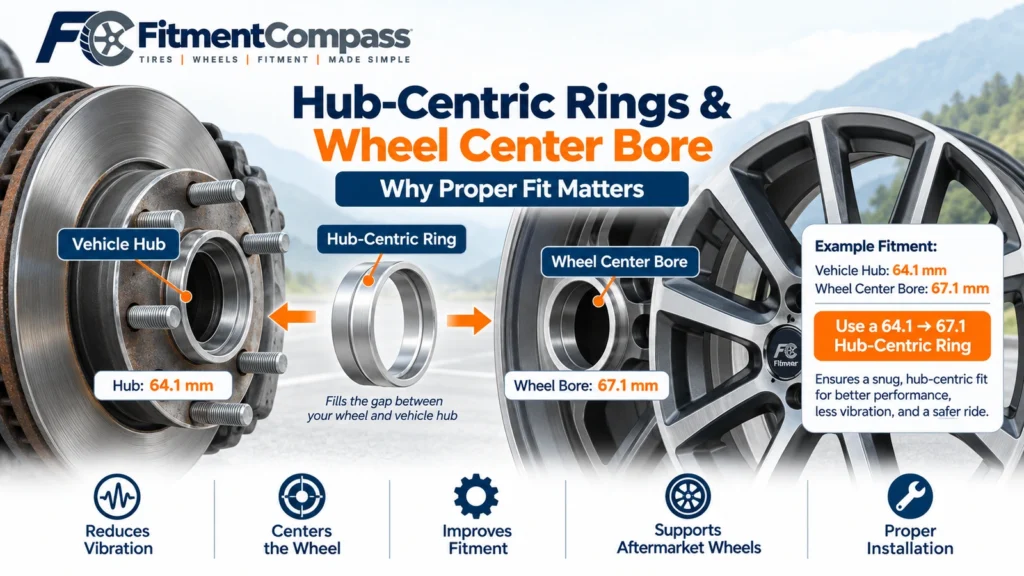
Hub centric rings are used in some wheel fitments when the center bore of an aftermarket wheel is larger than the vehicle’s hub pilot. The ring fills the gap between the wheel and hub so the wheel can be centered more precisely during installation.
To understand when a hub ring may be needed, it helps to first understand wheel center bore, hub diameter, and the difference between hub-centric and lug-centric wheel designs.
Center Bore at a Glance
- Wheel center bore: the opening in the center of the wheel.
- Vehicle hub pilot: the raised portion of the hub that fits inside the wheel center bore.
- Hub-centric wheel: the center bore fits the vehicle hub closely and helps center the wheel.
- Hub-centric ring: fills the gap when a compatible wheel has a center bore larger than the vehicle hub.
What Is a Wheel Center Bore?
The center bore is the circular opening in the middle of a wheel. This opening fits over the vehicle’s hub or hub pilot when the wheel is installed.
Center bore is generally measured in millimeters. Examples of wheel center-bore specifications might look like:
- 56.1 mm
- 57.1 mm
- 66.1 mm
- 67.1 mm
- 72.6 mm
- 73.1 mm
The correct measurement depends on the exact wheel and vehicle. These numbers should not be treated as interchangeable simply because they are close.
What Is the Vehicle Hub Bore?
The vehicle hub has a raised circular section that fits into the wheel’s center bore. This is commonly called the hub pilot or hub diameter.
For a direct hub-centric fit, the wheel’s center bore is designed to fit closely over this hub pilot.
The relationship between these two measurements is important:
- If the wheel center bore matches the vehicle hub appropriately, the wheel may have a direct hub-centric fit.
- If the wheel center bore is larger, a compatible centering ring may be used in applications designed for one.
- If the wheel center bore is smaller than the vehicle hub, the wheel cannot simply slide over the hub.
What Are Hub Centric Rings?
Hub centric rings, also called hub rings or centering rings, are circular inserts that fit between a wheel’s center bore and the vehicle’s hub pilot.
Their main purpose is to help center a compatible wheel precisely on the hub when the wheel’s center opening is larger than the vehicle hub.
They do not change the wheel’s:
- bolt pattern
- wheel diameter
- wheel width
- offset
- load rating
A hub ring therefore cannot make an otherwise incompatible wheel fit a vehicle.
How Hub Centric Ring Sizes Work
A hub ring normally has two important dimensions:
- Outer diameter (OD) — matches the wheel’s center bore.
- Inner diameter (ID) — matches the vehicle’s hub pilot.
For example, a ring marked approximately 73.1–67.1 mm would be intended to fit a wheel with a 73.1 mm center bore to a vehicle hub measuring approximately 67.1 mm.
Both dimensions need to be correct. Choosing a ring only from the vehicle hub size or only from the wheel center-bore size is not enough.
Hub-Centric vs Lug-Centric Wheels
Wheels may use different centering approaches depending on their design and application.
Hub-Centric Wheels
A hub-centric wheel has a center bore that fits closely around the vehicle’s hub pilot. The hub helps position the wheel concentrically during installation.
Original-equipment wheels are commonly designed specifically around a particular vehicle hub and therefore often use this type of fit.
Lug-Centric Wheels
A lug-centric wheel relies on the lug hardware and mounting arrangement to center the wheel rather than requiring the center bore to closely match the hub pilot.
Some aftermarket wheels use a larger center bore so one wheel design can be used for several compatible vehicle applications. Depending on the wheel system, centering rings may then be used to create a more precise hub-centered installation.
Do You Need Hub Centric Rings?
Not every wheel requires a hub ring.
A centering ring may be appropriate when:
- the aftermarket wheel has a larger center bore than the vehicle hub
- the wheel manufacturer designed the application to use centering rings
- the correct ring dimensions are available for both the wheel and vehicle
A direct-fit wheel with the correct center bore generally does not need an additional ring. Some lug-centric wheel applications may also be designed to operate without one.
Follow the wheel manufacturer’s fitment and installation requirements for the exact wheel and vehicle.
Can a Wheel Center Bore Be Larger Than the Hub?
Yes, in some properly specified aftermarket wheel applications. A wheel with a center bore larger than the vehicle hub can sometimes be installed if all other fitment specifications are correct and the wheel system is designed for that application.
A correctly sized hub-centric ring may be used to fill the difference between the larger wheel bore and smaller vehicle hub.
However, a larger center bore by itself does not mean the wheel is compatible. Bolt pattern, width, diameter, offset, load rating, brake clearance, and mounting hardware still have to be correct.
What If the Wheel Center Bore Is Too Small?
If the wheel’s center bore is smaller than the vehicle’s hub pilot, the wheel will not fit over the hub normally.
A hub-centric ring cannot solve this problem because rings reduce the effective size of a larger wheel bore; they do not make a small wheel bore larger.
Do not force a wheel onto a hub when the center bore does not provide adequate clearance.
Can the Wrong Center Bore Cause Vibration?
Improper wheel centering can contribute to vibration, particularly when an aftermarket wheel with a larger center bore is not centered correctly during installation.
A correctly sized centering ring can help position an appropriate wheel concentrically on the hub.
However, wheel vibration can have many other causes, including:
- wheel or tire imbalance
- bent wheels
- tire uniformity problems
- incorrect lug torque
- damaged mounting surfaces
- suspension or steering issues
A hub ring should therefore not automatically be assumed to solve every vibration problem.
Plastic vs Aluminum Hub Centric Rings
Hub centric rings are commonly available in plastic or resin materials as well as aluminum or other metal designs.
Plastic or Resin Rings
- lightweight
- commonly used for normal road applications
- resistant to corrosion between the ring and hub
- available in many size combinations
Aluminum Rings
- more rigid and durable
- available in many aftermarket fitments
- may require additional attention to corrosion or sticking depending on environment and materials
The correct dimensions and suitability for the wheel system are more important than choosing a ring based only on material.
Do Hub Centric Rings Carry the Vehicle’s Weight?
The primary role of a hub-centric ring is centering. It is not intended to change the wheel’s load rating or compensate for incorrect mounting hardware.
The wheel still needs the correct lug nuts or wheel bolts, proper seating surfaces, appropriate torque, sufficient load capacity, and full contact with the vehicle’s mounting surface.
Does Center Bore Affect Bolt Pattern?
No. Center bore and bolt pattern are separate specifications.
The bolt pattern describes the number and spacing of the mounting holes, while the center bore describes the size of the center opening in the wheel.
A wheel can have the correct bolt pattern but still have an incompatible center bore.
See What Is a Bolt Pattern? for a complete explanation of lug count and PCD.
Does Wheel Offset Affect Center Bore?
Offset and center bore are also separate measurements.
- Center bore determines how the wheel fits around the hub pilot.
- Offset determines the position of the wheel mounting surface relative to the wheel centerline.
Both can be correct or incorrect independently of one another.
See our guide What Is Wheel Offset? for more information.
Center Bore Is Only One Part of Wheel Fitment
A correctly sized center bore does not mean the wheel will automatically fit the vehicle.
Complete wheel fitment can also depend on:
- bolt pattern
- wheel diameter
- wheel width
- wheel offset
- backspacing
- brake clearance
- suspension clearance
- hub height
- wheel load capacity
- lug or wheel-bolt hardware
- tire compatibility
For a broader overview, see our Wheel Fitment & Wheel Specifications page.
Check Wheel Fitment by Vehicle
Research available tire and wheel specifications by year, make, model, and trim before selecting replacement or aftermarket wheels.
How to Check Center Bore Before Buying Wheels
Before purchasing or installing a replacement wheel:
- Confirm the vehicle hub-pilot diameter.
- Confirm the wheel center-bore diameter.
- Determine whether the wheel is a direct hub-centric fit or designed to use a centering ring.
- If a ring is required, confirm both its outer and inner diameters.
- Confirm the wheel bolt pattern.
- Check wheel diameter and width.
- Check offset and backspacing.
- Confirm brake and suspension clearance.
- Confirm wheel load rating and mounting hardware.
- Verify the fitment for the exact year, make, model, trim, and brake configuration.
Frequently Asked Questions
What are hub centric rings?
Hub centric rings are inserts that fill the gap between a compatible wheel’s larger center bore and a vehicle’s smaller hub pilot. They help center the wheel more precisely during installation.
Do I need hub centric rings?
Not every wheel requires them. They may be used when an aftermarket wheel has a larger center bore than the vehicle hub and the wheel application is designed to use a centering ring.
Can a wheel center bore be larger than the vehicle hub?
Yes, in some properly specified aftermarket wheel applications. A correctly sized hub-centric ring may be used to fill the difference, but all other wheel-fitment specifications must also be correct.
Can a wheel center bore be smaller than the vehicle hub?
A wheel with a center bore smaller than the vehicle hub will not normally fit over the hub. A hub-centric ring cannot fix this because rings reduce a larger bore rather than enlarge a smaller one.
Do hub centric rings stop wheel vibration?
Correctly sized rings can help center an appropriate wheel and may reduce vibration caused by poor centering. However, vibration can also result from wheel balance, damaged wheels or tires, improper torque, suspension issues, or other causes.
Are plastic or aluminum hub centric rings better?
Both materials are commonly used. Plastic or resin rings resist corrosion and are widely used, while aluminum rings provide greater rigidity and durability. Correct sizing and compatibility with the wheel application are more important than material alone.
Fitment note: Center bore and hub-ring compatibility are only parts of wheel fitment. Always verify the exact vehicle, wheel dimensions, bolt pattern, offset, brake and suspension clearance, load rating, mounting hardware, and wheel-manufacturer requirements before installation.


