
How to Read a Tire Size: Numbers & Letters Explained
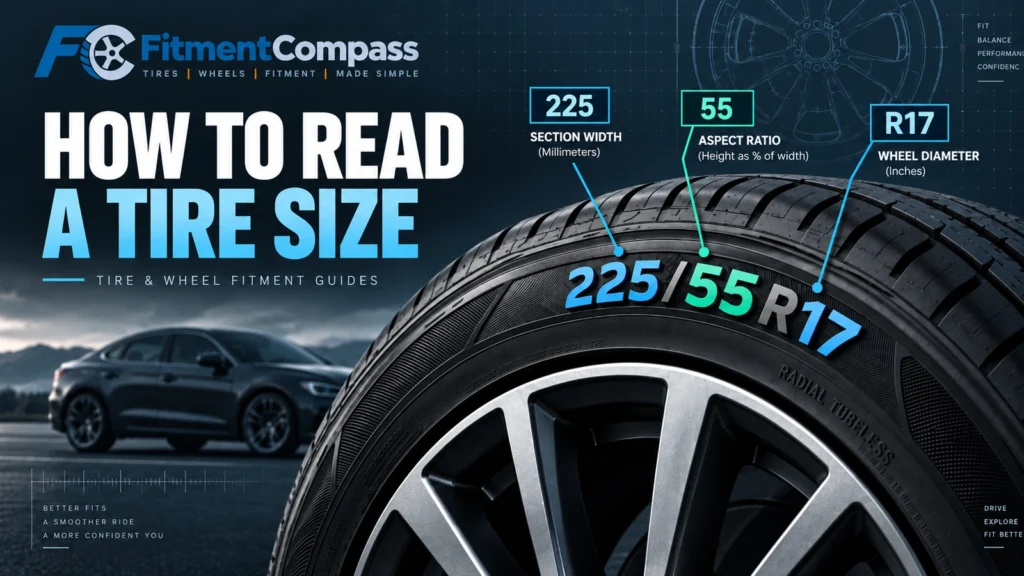
If you have ever looked at the side of a tire and seen a code such as 225/65R17 102H, the numbers and letters can seem complicated at first. Each part of that code describes an important tire specification, including width, sidewall height, wheel diameter, load capacity, and speed rating.
This guide explains how to read a tire size step by step, what the tire numbers and letters mean, and which measurements matter when checking tire and vehicle fitment.
Quick Example: What Does 225/65R17 Mean?
In the tire size 225/65R17:
- 225 = nominal tire width in millimeters
- 65 = sidewall height as a percentage of tire width
- R = radial tire construction
- 17 = wheel diameter in inches
If the tire also shows 102H, the number 102 is the load index and H is the speed rating.
How Tire Size Numbers Work
Most passenger-vehicle tire sizes use a format similar to:
225 / 65 R 17 102 H
Although these values appear together on the sidewall, they describe different characteristics of the tire. Understanding each part makes it easier to compare tires, check specifications, and understand how a tire may affect vehicle fitment.
1. Tire Width: 225
The first number is the tire’s nominal section width in millimeters. In a 225/65R17 tire, the nominal width is 225 mm.
This does not mean every tire labeled 225 will measure exactly 225 mm when mounted. Actual dimensions can vary somewhat by tire model, manufacturer, measuring rim width, inflation pressure, and load.
A larger first number generally indicates a wider tire. For example, a 245-width tire is nominally wider than a 225-width tire, but width alone does not determine whether a tire will fit a vehicle.
2. Aspect Ratio: 65
The second number is the aspect ratio. It describes the sidewall height as a percentage of the tire’s nominal width.
For a 225/65R17 tire, the aspect ratio is 65. That means the calculated sidewall height is approximately 65% of 225 mm.
The calculation is:
225 × 0.65 = 146.25 mm
So the calculated sidewall height is about 146 mm.
A lower aspect ratio usually produces a shorter sidewall relative to tire width, while a higher aspect ratio produces a taller sidewall.
3. What Does R Mean on a Tire?
The letter R in a tire size stands for radial construction. Radial tires use body-cord plies arranged generally across the tire from bead to bead.
Radial construction is common on modern passenger vehicles, SUVs, and light trucks. The R does not mean rim or radius.
4. Wheel Diameter: 17
The number after the construction letter identifies the tire’s intended wheel diameter in inches.
A 225/65R17 tire is designed for a 17-inch wheel. A tire marked R18 is designed for an 18-inch wheel, while an R20 tire requires a 20-inch wheel.
This dimension must match the wheel diameter. A 17-inch tire cannot simply be installed on an 18-inch wheel.
What Do the Numbers After the Tire Size Mean?
A complete tire description often contains additional numbers and letters after the basic size. For example:
225/65R17 102H
The final 102H is often called the tire’s service description.
Load Index: 102
The load index is a numerical code associated with the maximum load a properly inflated tire can support under specified conditions.
It is important not to replace a tire with one that has an inadequate load capacity for the vehicle. Check the vehicle placard, owner’s documentation, and tire manufacturer’s specifications when selecting a replacement.
Speed Rating: H
The final letter is commonly the tire’s speed rating. It identifies a standardized speed capability under specified test conditions.
Common speed-rating letters include T, H, V, W, and Y, but the correct replacement specification depends on the vehicle and tire application.
A speed rating should not be interpreted as a recommendation to drive at that speed. Vehicle condition, road conditions, tire pressure, load, temperature, local laws, and many other factors affect safe operation.
What Do P and LT Mean on a Tire?
Some tire sizes include letters before the width number.
- P generally identifies a P-metric passenger tire.
- LT generally identifies a tire intended for light-truck applications.
For example, you may see P225/65R17 or an LT-designated tire size. These designations can be associated with different load and inflation standards, so a P-metric tire and an LT tire should not be treated as automatically interchangeable simply because other size numbers look similar.
Tire Size Example Breakdown
| Marking | Example | What It Means |
|---|---|---|
| Width | 225 | Nominal section width in millimeters |
| Aspect ratio | 65 | Sidewall height is 65% of nominal width |
| Construction | R | Radial construction |
| Wheel diameter | 17 | Designed for a 17-inch wheel |
| Load index | 102 | Standardized load-capacity code |
| Speed rating | H | Standardized speed-rating code |
Does Tire Size Tell You the Actual Tire Diameter?
Not directly, but the basic metric tire size contains enough information to calculate an approximate overall diameter.
The calculation uses:
- tire width
- aspect ratio
- wheel diameter
For example, the sidewall of a 225/65R17 tire is approximately 146.25 mm tall. Two sidewalls plus the 17-inch wheel diameter give an approximate unloaded tire diameter.
For quick calculations and conversions, use the Tire Size Converter or browse our tire size dimensions.
Why Two Tires With the Same Size Can Measure Differently
A tire size such as 225/65R17 is a standardized nominal designation, but two different tire models carrying that size do not necessarily have perfectly identical mounted dimensions.
Actual measurements can vary because of:
- tire manufacturer and model
- tread design and tread depth
- approved rim-width range
- measuring rim width
- inflation pressure
- vehicle load
- manufacturing tolerances
For clearance-sensitive applications, always check the manufacturer’s published specifications for the exact tire model rather than relying only on calculated dimensions.
How to Find the Correct Tire Size for Your Vehicle
The tire currently installed on the vehicle can provide useful information, but it should not always be assumed to be the original or correct specification. A previous owner may have changed the tire or wheel size.
Useful places to confirm vehicle tire specifications include:
- the tire and loading information placard
- vehicle owner’s documentation
- manufacturer fitment information
- reliable vehicle-specific tire and wheel data
You can also use our Vehicle Tire & Wheel Fitment section to research available fitment records by year, make, model, and trim as the FitmentCompass database expands.
Can You Use a Different Tire Size?
Sometimes a vehicle can use more than one tire size, but a different size should not be selected based only on whether it physically mounts to the wheel.
Changing tire size can affect:
- overall tire diameter
- ride height
- speedometer and odometer readings
- fender and suspension clearance
- tire-to-wheel compatibility
- load capacity
- handling
- brake and drivetrain behavior on some vehicles
Before changing sizes, use the Tire Size Comparison Calculator to compare width, sidewall height, diameter, circumference, revolutions per mile, and estimated speedometer changes.
Compare Tire Sizes Before Making a Change
Compare two tire sizes to see changes in diameter, width, sidewall height, circumference, revolutions per mile, ride height, and estimated speedometer difference.
How to Read a Tire Size at a Glance
Using 225/65R17 102H as an example:
- 225 tells you the nominal tire width in millimeters.
- 65 tells you the sidewall height is approximately 65% of the tire width.
- R identifies radial construction.
- 17 identifies the wheel diameter in inches.
- 102 is the load index.
- H is the speed rating.
These markings are an important starting point, but correct fitment also depends on the exact vehicle, wheel specifications, load requirements, clearances, and manufacturer recommendations.
Frequently Asked Questions
What do the three tire size numbers mean?
In a tire size such as 225/65R17, 225 is the nominal tire width in millimeters, 65 is the aspect ratio, and 17 is the wheel diameter in inches. The letter R identifies radial tire construction.
What does the R mean in a tire size?
The letter R means radial construction. It describes how the tire’s internal body plies are arranged. It does not mean rim or radius.
What does 225/65R17 mean?
A 225/65R17 tire has a nominal width of 225 mm, an aspect ratio of 65%, radial construction, and is designed for a 17-inch wheel.
What do the last number and letter on a tire mean?
In a marking such as 102H, 102 is the tire’s load index and H is its speed rating. These values describe standardized load capacity and speed capability under specified conditions.
Does a wider tire always fit the same vehicle?
No. Tire width is only one part of fitment. Wheel width, tire diameter, wheel offset, suspension and fender clearance, load requirements, and vehicle specifications can all affect whether a wider tire fits correctly.
Can I use a different tire size than the one on my vehicle?
Some vehicles support more than one tire size, but a replacement size should be checked for overall diameter, wheel compatibility, clearance, load capacity, speedometer effects, and vehicle-specific requirements before installation.
Fitment note: Tire dimensions calculated from a size code are theoretical values. Actual mounted dimensions may differ by tire model, manufacturer, approved rim width, inflation pressure, and load. Always confirm the exact vehicle and tire specifications before purchasing or installing a replacement size.


